When AI tools can answer any question in seconds, what is the point of education that focuses on memorising facts? Here is what early years schools in Hyderabad should be building instead.
For most of the last century, early childhood education measured progress by one thing. How quickly a child could retrieve information. Recite the alphabet. Name the colours. Count to twenty. The assumption was that storing the right facts was the foundation of a good education.
That assumption made sense when information was scarce and hard to access. It makes almost no sense now.
A child sitting in a preschool in Hyderabad today will enter the workforce in the 2040s. The tools available to them will be unrecognisable compared to anything we can fully predict. What will not change is the need to think clearly, to ask the right questions, to sit with a problem long enough to understand it before reaching for a solution.
The schools that prepare children for that future are not the ones drilling letters and numbers the fastest. They are the ones treating curiosity as a skill worth developing, not a tendency to manage.
If machines can provide the answers instantly, then the premium human skill is no longer knowing the answer. It is knowing what to ask.
Consider what happens when children notice puddles drying up on a playground after rain. A conventional approach names this evaporation, adds it to a vocabulary list, and moves on. The word is learned. The understanding is shallow.
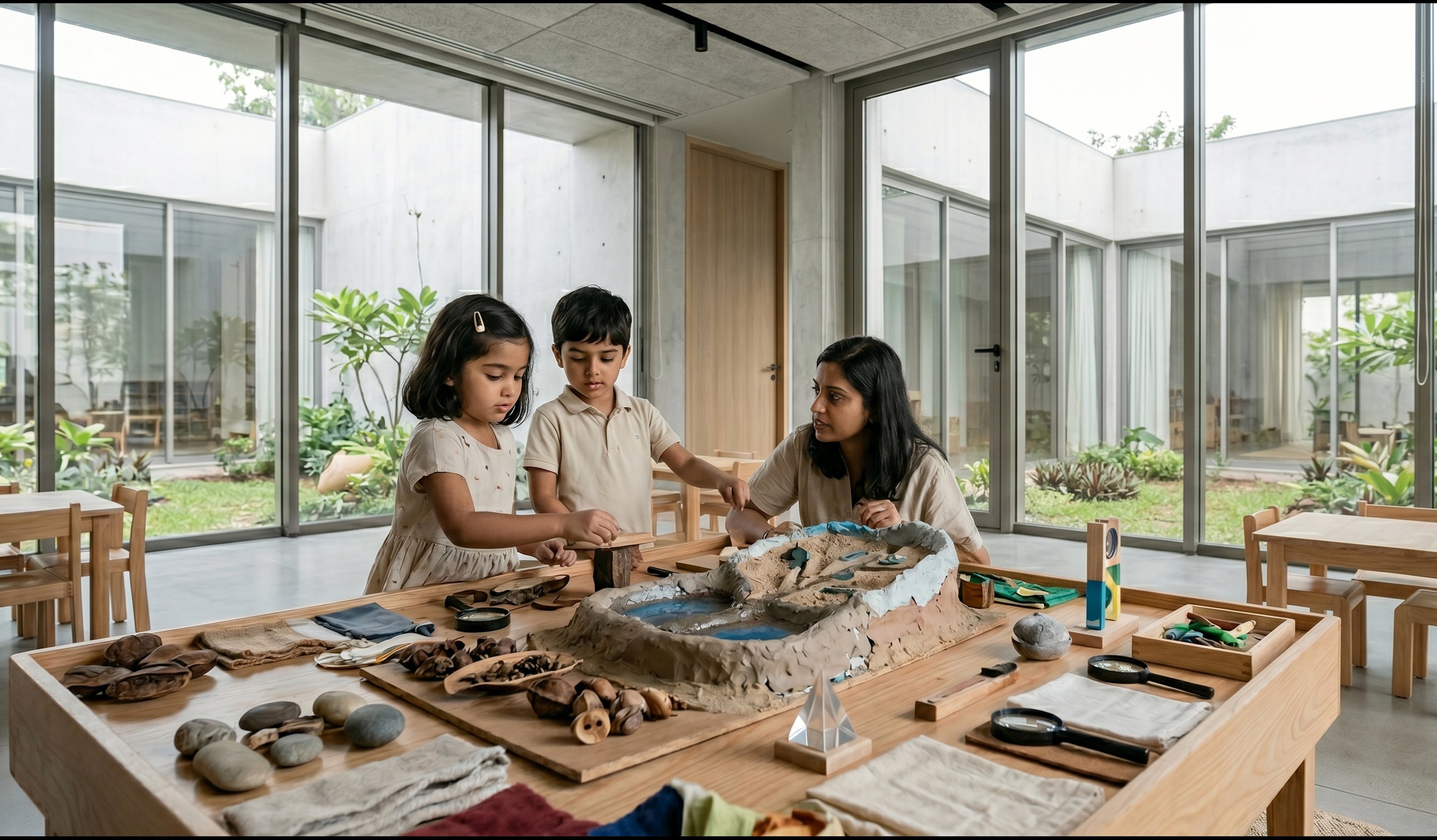
In an inquiry-led environment, the puddle is a starting point, not a fact to be filed. Children measure how much water remains. They test what happens when they cover part of a puddle and leave part exposed. They map changes over an hour, then a day. They argue about why the shaded side dried more slowly. They form a hypothesis, test it, and revise it when the results surprise them.
By the end, they have not just learned what evaporation is. They have practiced how to observe carefully, how to isolate a variable, how to be wrong and useful at the same time. These are not science skills. They are thinking skills. They transfer to everything.
When a child's block tower falls for the fifth time, something important happens in their brain. The failure creates what developmental science calls productive difficulty, the experience of working through something genuinely challenging, a moment where the current mental model does not match reality. The brain is forced to adapt. To rebuild the model. To try something different.
This process, repeated across hundreds of small moments of inquiry over years, builds what researchers identify as executive function, the ability to hold a problem in mind, shift perspective, and regulate the impulse to give up. These capacities predict academic and life outcomes more reliably than early literacy or numeracy alone.
A worksheet teaches a child that there is one right answer and the task is to find it. Inquiry teaches them that most worthwhile problems have no single answer, and the task is to think more clearly about the question.
The tactile, three-dimensional nature of inquiry learning matters in ways that are easy to underestimate. A child testing gravity with a real object experiences something categorically different from watching a video about gravity or tapping through an app that simulates it. The weight of the object, the sound it makes, the feel of the surface it lands on. All of this sensory information contributes to the richness of the mental model being built.
This is one of the reasons a screen-free environment is not simply a preference at Kawa. It is a considered position about what kind of learning we are trying to build. A child who has spent years building real things, testing real materials, and having real conversations with a curious educator is developing something a screen cannot replicate and a generative AI tool cannot replace.
At Kawa, we do not treat children's questions as interruptions to the lesson. We treat them as the lesson. When a four-year-old asks why the ice cube in the cup melted faster than the one on the table, we do not give the answer. We ask what they think might be happening. We suggest they try it again and watch more carefully. We give them the time to sit with the problem.
The goal is not to withhold information. It is about something more important, building the habit of thinking before reaching for an answer. The habit of forming a question carefully. The habit of staying with a problem when it gets difficult, rather than waiting for someone to resolve it.
That habit, formed between ages two and six, is the most durable thing we can build. The content of what children learn in these years matters far less than the relationship they develop with learning itself.
Parents sometimes worry that an inquiry-led approach delays the academic foundations their child will need for school. The evidence says the opposite. Children who develop strong thinking skills, genuine curiosity and the ability to persist through difficulty reach primary school not behind their peers, but with something their peers often lack, an internal engine for learning that does not depend on external reward or instruction.
They are the children who ask their teachers better questions. Who approach an unfamiliar problem with interest rather than anxiety. Who, a decade from now, will be able to work alongside whatever tools their generation inherits in ways that make those tools more useful, not because they were trained for a specific future, but because they were taught how to think.
At Kawa Early Years, a screen-free early years school in Nallagandla, Hyderabad, inquiry is not a feature of the programme. It is the programme. Every environment, every material, every educator interaction is designed to build children who know how to ask better questions. Enquire now.
Sources & further reading
Where this article references research, we aim to reflect what the evidence actually supports. Strong findings are stated as such. Associations are described as associations. Kawa’s educational choices are identified as choices, not as scientific conclusions.
We answer every enquiry personally. No automated responses.
Enquire Now